Organisations have never invested more in skills.
Skills frameworks, skills taxonomies, skills academies, skills passports, certifications stacked on certifications.
This investment matters. Structured skill development, thoughtful learning design, and increasingly sophisticated digital delivery have advanced enormously over the past two decades.
These systems build knowledge, create clarity, and raise the baseline, and yet, performance outcomes still vary. Not because learning is absent or development is flawed, but because something influences what happens after the training ends.
People complete the program, they earn the credential, they can describe the skill, but when it matters…when it becomes complex – under pressure, in context, in the real world, application differs, and results diverge.
The insight we often miss is this:
Skills alone don’t create value.
Skills applied create compounding value.
Value in organisations isn’t generated once.
It’s generated repeatedly – in moments of pressure, in difficult conversations, in decisions made when no one is watching.
And that repetition is what compounds performance over time.
Application is governed by factors more predictive than skills alone.
Capability: the link between skill and performance
Capability sits between having a skill and using it.
It reflects a person’s desire, will, and stamina to apply that skill consistently in the conditions the work demands.
Two people can hold the same qualification, complete the same training and demonstrate the same skill in a controlled environment.
But if only one has the underlying capability to want to do it, persist with it, and apply it repeatedly, outcomes will differ.
Capability does not replace skills.
It governs whether those skills are applied, sustained, and effective in the real work context.
This is where precision begins.
When “communication” isn’t one thing
Consider a skill that appears in many work profiles: communication. On paper, it looks universal. In practice, it isn’t.
Take two bodies of work that both “require strong communication”:
- Business Development
- Account Management
At a high level, they look similar, but the communication that drives success in each is different.
Business Development often requires building networks – fast, broad, opportunity-driven connections – initiating contact, opening doors.
Account Management requires building customer relationships in depth over time. Trust. Continuity. Nuance.
Both sit under “communication.”
Both are trained as communication skills.
But they draw on different underlying capabilities.
Treat them as interchangeable and you introduce friction that reduces the impact of even well-designed learning.
The fuel gauge model
Think of work readiness as three gauges:
- Certification – formal proof of skill or knowledge
- Experience – time spent applying the skill in real situations
- Capability – the intrinsic drive and stamina to apply it consistently.
All three matter.
But capability governs whether certification and experience translate into sustained performance.
High–High–High
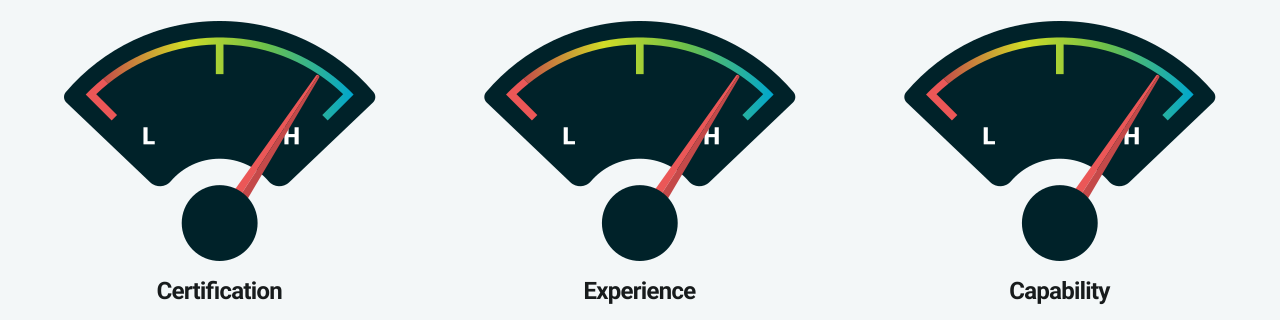
High certification.
High experience.
High capability.
Performance compounds.
Development amplifies strength.
High–High–Low
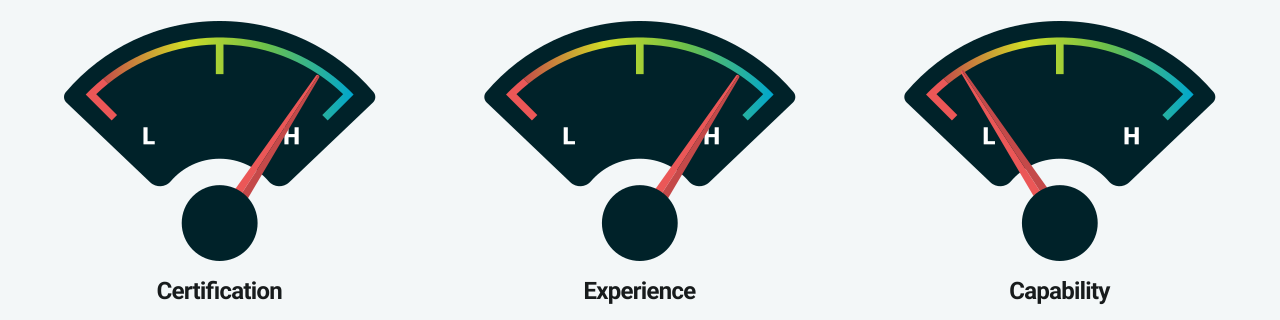
High certification.
High experience.
Low capability.
On paper, this looks strong. In practice, friction appears.
Not because skills are absent, but because capability misalignment is invisible. This is where disciplined development becomes critical.
When work demands behaviours that are not yet instinctive, learning strategy must move beyond exposure and into reinforcement, structured practice, and behavioural calibration.
Done well, this is where development makes the greatest difference.
Low–Low–High
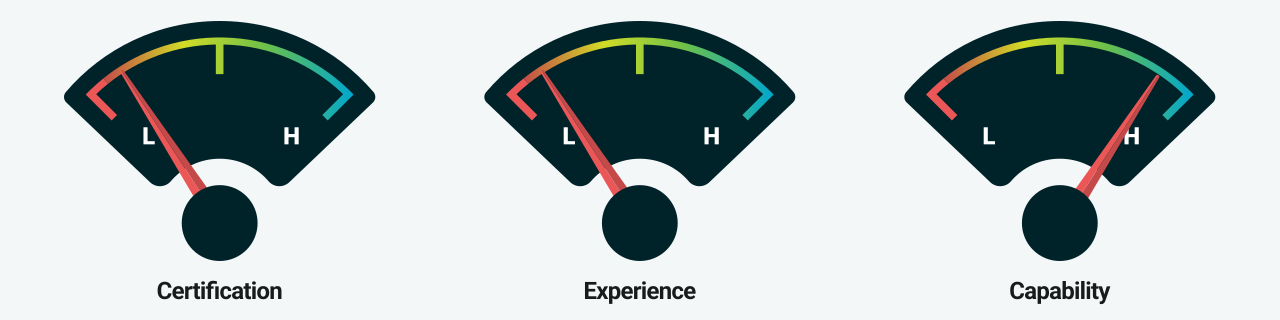
Low certification.
Low experience.
High capability.
This is where potential lives.
These individuals want to do the work, they persist when it’s difficult, and they gain energy from applying the skill.
With structured training and opportunity, they often accelerate quickly because capability drives skill acquisition and application.
Why precision changes outcomes
When organisations operate one layer too high – at generic skills and broad competencies, they lose signal.
They assume relevance.
They mask friction.
They risk misallocating development effort.
Precision means understanding:
- Which specific skills matter in this body of work
- Under what conditions they must be applied
- And who has the underlying capability to apply them consistently
This doesn’t replace training, it sharpens it.
It allows learning strategists to design with clarity – amplifying where strength exists and reinforcing where friction appears.
The future of work (AI this, LLMs that, GPT version next… all of it)
The “future of work” is often reduced to AI, LLMs, and the next GPT release, but the deeper shift isn’t just technological, it’s human.
As technology absorbs repetitive and transactional work, the human layer that remains becomes more nuanced, relational, judgment-driven, and capability-intensive.
In other words, capability matters more – not less.
This raises the bar for learning strategy.
When capability insight is visible:
High capability → amplify and accelerate.
Emerging capability → reinforce and structure.
Hidden potential → invest early.
The opportunity isn’t less training, it’s better-aligned training that compounds value.
The practical shift
The shift isn’t away from skills; it’s away from skills in isolation.
When capability is measured alongside certification and experience – and when work is defined with precision, organisations stop guessing.
They stop hiring for paper strength alone, and they stop training at generic levels.
They align work to where capability is strong – and invest intentionally where reinforcement is required.
And the organisations that win won’t just know what skills their people have.
They’ll know who will apply them – repeatedly, under pressure, when it matters, and in different environments where performance actually lives.
And that’s when skills finally do what they were always meant to do:
Translate into real, repeatable, compounding business outcomes.