
Contents
Losing people in critical roles is inevitable. Losing their replacement within 12 months is not. Effective succession planning has moved on from guess work to a far superior predictor of performance: capability.
Why succession plans often fail
Most succession plans fail for the same reason: the underlying process is built on assumptions about who’s ready, not evidence. When the moment comes, the person you promoted isn’t up to the task, and your ideal successor quietly leaves the organisation. Often scheduled as an afterthought following annual performance reviews, succession plans can also fail when seen as a ‘set and forget’ annual activity, instead of one of regular review and action.
What is succession planning?
Put simply, succession planning identifies people who could step up into a critical role or leadership position in your business should the current incumbent leave your organisation or be promoted in the short, medium or long term. Successors, or those people you identify as being suitable for appointment, may or may not be within your organisation. Companies of all sizes can have succession plans and need not have formal complex systems in place to manage them.
3-step succession planning process
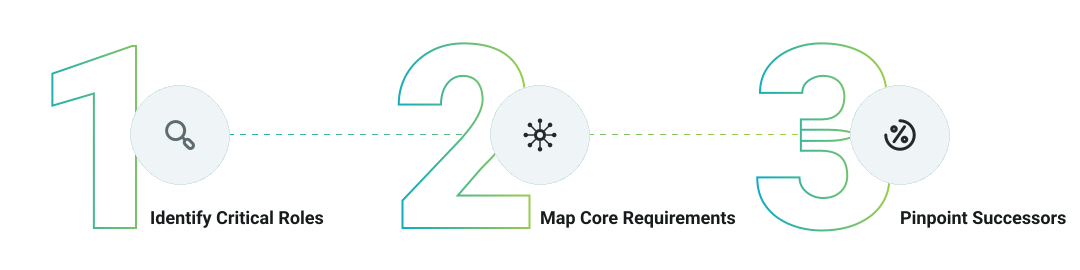
The key steps of succession planning are to:
- identify which roles in your organisation are critical to the day-to-day operations of your organisation,
- understand the core requirements for those key roles and
- have a plan for how to replace the current incumbent when the time comes.
Typically, succession plans focus on the most senior people in the organisation, however, some companies identify roles outside of their senior executives as being critical for their operational continuity. For example, hospitals cannot function without cleaners. Airlines cannot operate without pilots. Not all critical roles contain the word “chief” in their title.
Why should I have a succession plan?
Organisations that have a succession strategy have an insurance policy against critical business disruptions should someone central to the organisation’s operations leave their role for whatever reason. If your company is in a fortunate position where replacing existing staff members is easy and talent is in great supply, you may not need a succession plan, as you should be able to replace any vacancy quickly without needing external talent. If, however, your organisation operated in talent markets that experience scarcity, or require knowledge one can only gain on the job, you likely need a succession plan.
Does a succession plan need to be an annual event?
Ah, this is an age-old question. In a word, ‘no’. Many organisations believe that having an annual succession planning routine, usually following performance reviews, is of strategic benefit. In our collective experience, this is an excellent baseline for large organisations to formalise succession planning at least annually. Best practice succession planning is an ongoing process and is updated throughout the year as appropriate.
The answer is that your succession plan must keep pace with the ebbs and flows of people coming and going, and that doesn’t happen just once a year. Importantly, where a single employee is nominated as a successor for multiple roles, should they leave the organisation or be promoted, their status as a successor for the remaining roles needs to be reconsidered. They may need to be removed from all other roles, or returned to “ready in 12 months +”. One way to remain on top of your organisation’s succession planning is to routinely evaluate the capabilities required for the critical roles in your organisation, and routinely evaluating your existing talent for their suitability for promotion.
Identifying your critical roles
Most organisations with succession plans focus on leadership succession planning. For many, this is all that is needed to future-proof their workforce and all other roles can easily be replaced. For some, deciding which roles are critical can seem complicated, especially if no senior leadership functions are identified as critical roles (and in some cases, reaching that conclusion can feel like a career limiting move).
The questions that help determine whether a role is critical include:
- If this person / these people won the lottery and didn’t turn up to work tomorrow, would the business function without them?
- Could you fill a vacancy for this role quickly enough for it not to impact revenue/critical operations?
- Do you have people in the organisation who could quickly get up to speed if promoted?
If you answer no to two or three of these, you could be looking at a critical role.
Why a 9-box grid isn’t enough for effective succession planning
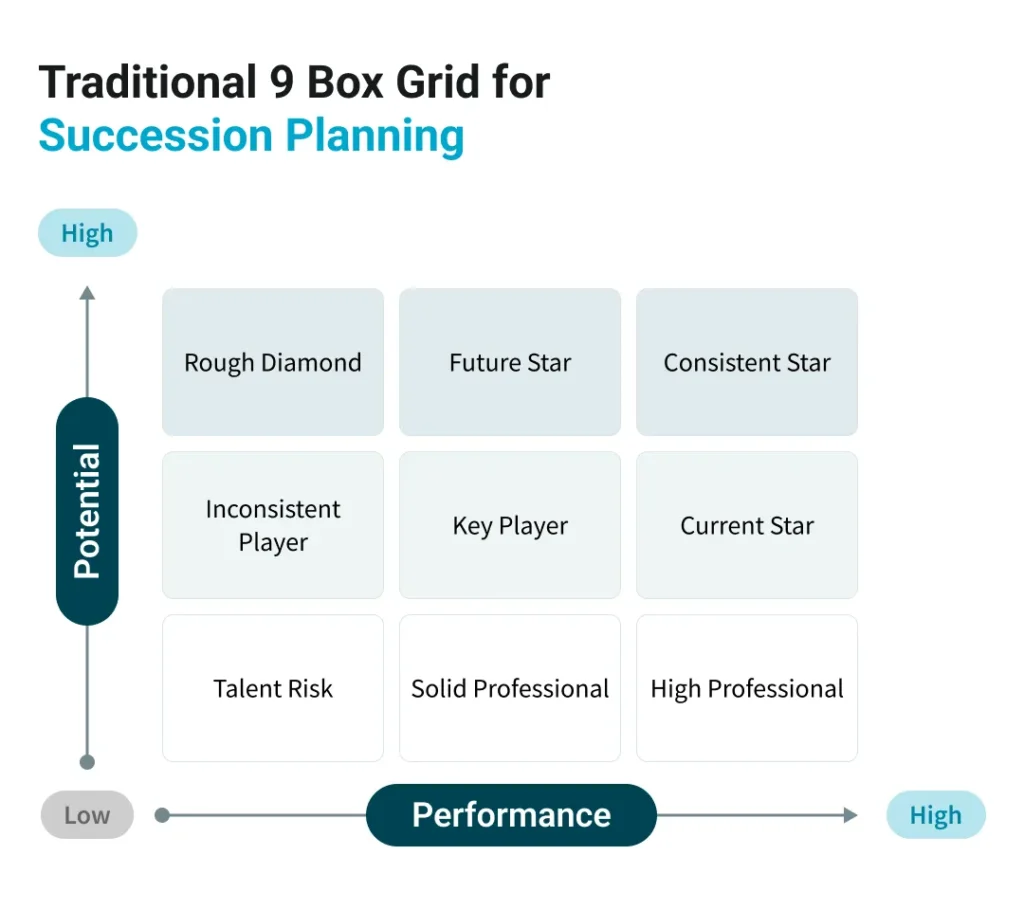
A nine-box grid typically categorises people who have been identified as likely successors on two axes, often Performance vs Potential, Readiness vs Performance etc., or a mix of factors relevant to the organisation. As an input to the decision, 9-box grids are important, but they cannot be relied upon to determine successors in isolation.
Performance typically refers to the most recent performance review rating, which his often calibrated, subjectively, against one’s peers.
Potential is most commonly influenced by manager discretion passed up the line to the senior executives who prepare succession plans in larger organisations. Rarely is it evidence-based, except with influence from a recent performance review or standout event.
Readiness is, again, often a subjective assessment by a manager determining how soon the person will be ready to step up into the role. This metric can prove unreliable if the manager or employee is new to the organisation.
What these grids lack is objective evaluation of what is required for the roles and evidence of who has the capability to perform these roles. That’s where AbilityMap adds the objective reference for succession planning, to identify who possesses the natural capability to perform at the level required for each role, and will likely thrive given the opportunity. This is often overlooked when relying on manager’s observation of performance, and when the role requirements are not clearly articulated.

Identifying suitable successors
If you have clearly identified what each critical role requires (skills, qualifications, experience and capabilities), then identifying your successors becomes an exercise of matching your employees to the needs of the role. By evaluating the capabilities of all potential successors, you can quickly gauge who has the necessary capabilities and assess your bench strength for each critical role. AbilityMap evaluates the overall role fit, as well as the strength per capability for each role so you can target specific development areas for each nominated successor.
Future-proof your workforce by developing your next generation of leaders
Suitable successors who meet all relevant criteria can be considered ‘ready now’ for promotion, and these people should be given opportunities to act while the incumbent is on leave, access mentoring opportunities to learn the complexities of the role or supported to undertake further study to be ready when the time comes. Those with strong capability fit who perhaps lack some experience should be encouraged to work in roles that will help develop their operational knowledge and functional skills, and access external training or study opportunities as needed. Companies that invest in employee development report higher employee engagement, job satisfaction, higher retention.
Harvard Business School: Why Employee Training Pays Companies Twice
Deloitte: Benefits of Investing in Staff Training
Managing your succession journey
Anyone nominated as a successor to a role should be considered among your high potential employees. A plan for how to prepare each high potential employee should be considered depending on the role (or roles) for which they are nominated. If you are lucky enough to be given advance notice, such as with a retirement, you have the luxury of time to nominate a successor and establish a formal mentoring and handover process before the inevitable departure.